
Unlock Your Strength: 5 Essential Weight Bench Workouts for Beginners
Are you ready to transform your fitness journey and build a stronger, more confident you? If you’ve recently invested in a weight bench for your home gym, or are considering adding one, you’ve made an excellent choice! A workout bench is an incredibly versatile piece of equipment that can unlock a wide range of exercises, especially when combined with free weights like dumbbells or a barbell.
For beginners, stepping into strength training can feel intimidating. However, mastering the fundamentals using a weight bench provides the stability, support, and range of motion necessary to build a rock-solid physical foundation. This comprehensive guide is designed specifically for beginners, offering five fundamental exercises, proper biomechanical breakdowns, common mistakes to avoid, and a structured beginner routine to maximize your results at home.
Why a Weight Bench is Your Home Gym Essential
Before diving into the exercises, let’s briefly discuss why a weight bench is such a game-changer for home fitness.
When performing exercises on the floor (such as a floor press or floor bridge), your range of motion is strictly limited by the ground. Your elbows hit the floor before your chest can fully stretch, and your back support is flat and unnatural. A quality weight bench solves these limitations by:
- Unlocking Full Range of Motion:Allowing your arms and shoulders to move through a complete biomechanical arc, resulting in deeper muscle fiber recruitment.
- Providing Core and Spinal Support:Stabilizing your upper back and spine so you can safely lift heavier loads without straining your lower back.
- Offering Adjustable Angles:Flat, incline, and decline positions allow you to target different areas of major muscle groups (such as the upper and lower chest) with pinpoint precision.
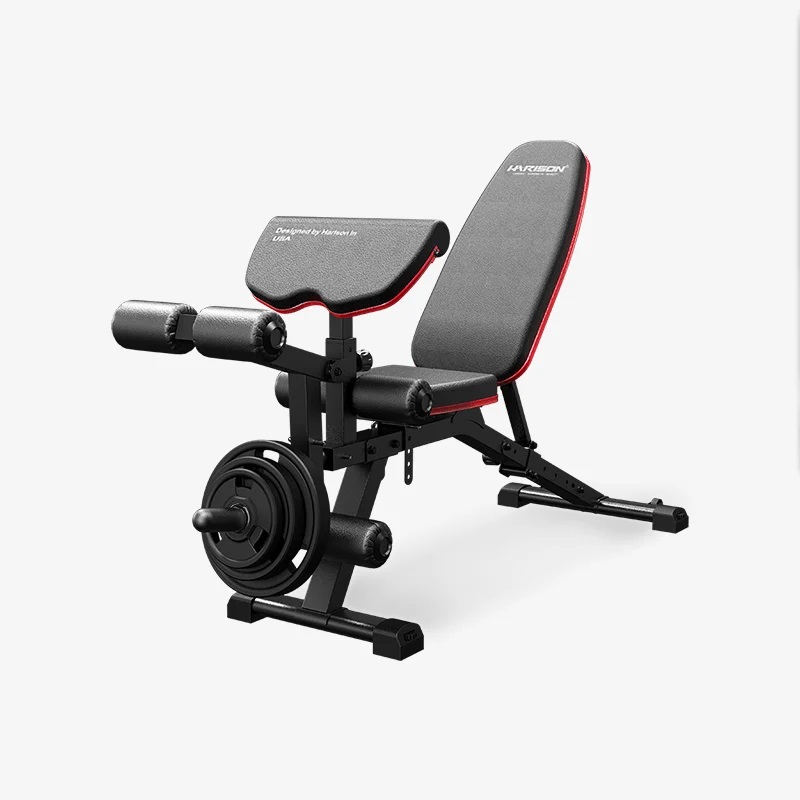
HARISON HR-609 Adjustable Weight Bench
The 5 Essential Weight Bench Exercises for Beginners
Here are five foundational exercises to get you started, focusing on proper form, controlled movements, and targeted muscle engagement. Remember to always start with light free weights to master the technique before increasing the load.
1. Dumbbell Bench Press
* Target Muscles: Pectoralis major (chest), anterior deltoids (shoulders), triceps brachii.
* Why It Matters: This is the ultimate upper-body pressing movement. Unlike a barbell, dumbbells require each arm to work independently, correcting muscular imbalances and engaging deep stabilizer muscles.
* How to Perform:
- Lie flat on your back on the weight bench with your feet planted firmly flat on the floor to create a stable base.
- Hold a dumbbell in each hand at chest level, palms facing forward (away from you), with your elbows bent at roughly a 90-degree angle.
- Press the dumbbells straight up in a controlled motion until your arms are fully extended over your chest, without locking your elbows at the top.
- Slowly and deliberately lower the dumbbells back down to the starting position, feeling a gentle stretch across your chest.
* Pro Tip: Keep your shoulder blades retracted (“pinned” into the bench) throughout the entire movement to protect your shoulder joints.
2. Supported Dumbbell Rows
* Target Muscles: Latissimus dorsi (lats), rhomboids, rear deltoids, biceps.
* Why It Matters: Many beginners suffer from “desk posture” (rounded shoulders). Rows strengthen the pulling muscles of the upper back, improving posture and balancing out your pressing strength.
* How to Perform:
- Place your left knee and your left hand flat on the weight bench for stable support. Your back should be straight and roughly parallel to the floor.
- Hold a dumbbell in your right hand, letting your arm hang fully extended toward the floor.
- Pull the dumbbell upward toward your hip/lower ribcage, leading with your elbow and squeezing your shoulder blade at the very top of the movement.
- Lower the weight slowly back to the starting position. Complete all reps on one side before switching to the other.
* Pro Tip: Avoid twisting your torso as you lift. Keep your hips square to the bench.
3. Incline Dumbbell Press
* Target Muscles: Clavicular head of the pectoralis major (upper chest), anterior shoulders, triceps.
* Why It Matters: The flat bench press builds overall chest mass, but the incline press specifically targets the upper chest, creating that full, well-rounded aesthetic while preventing upper-shelf sagging.
* How to Perform:
- Adjust your workout bench to an incline of approximately 30 to 45 degrees.
- Sit back on the bench with a dumbbell in each hand resting on your thighs, then kick them up to your shoulders as you lie back.
- Press the dumbbells upward and slightly inward, focusing on squeezing your upper chest at the peak contraction.
- Lower the weights with control until they are level with your upper chest.
* Pro Tip: Do not set the incline too high (above 60 degrees), or the movement turns into a shoulder press rather than a chest exercise.
4. Weighted Step-Ups
* Target Muscles: Quadriceps, gluteus maximus, hamstrings, core stabilizers.
* Why It Matters: Leg training is often neglected on benches, but step-ups are a phenomenal functional movement that mimics climbing stairs, enhances single-leg stability, and builds incredible lower body strength.
* How to Perform:
- Stand facing your weight bench, holding a light dumbbell in each hand by your sides.
- Place your right foot firmly flat on top of the bench.
- Drive through your right heel, engaging your glute and quad to lift your entire body up onto the bench until your left leg joins it.
- Step backward down with your left foot first, followed by your right foot.
- Alternate your leading leg with each repetition.
* Pro Tip: Never push off the floor with your trailing foot; let the leg on the bench do 100% of the lifting work.
5. Dumbbell Pullovers
* Target Muscles: Latissimus dorsi, pectoralis major, serratus anterior, triceps, and core.
* Why It Matters: The pullover is a classic bodybuilding movement that expands the ribcage, stretches the thoracic fascia, and works both the upper back and chest simultaneously.
* How to Perform:
- Lie perpendicular (across) the weight bench so that only your upper back and shoulders are supported by the pad, with your feet planted flat on the floor and hips dropped slightly downward.
- Hold a single dumbbell with both hands directly above your chest, arms slightly bent at the elbows.
- Inhale deeply as you slowly lower the dumbbell in a smooth arc backward behind your head until it is level with the bench.
- Exhale as you pull the dumbbell back over your chest using your lats and chest muscles.
* Pro Tip: Keep your hips stable and your core braced to prevent your lower back from arching excessively during the stretch.
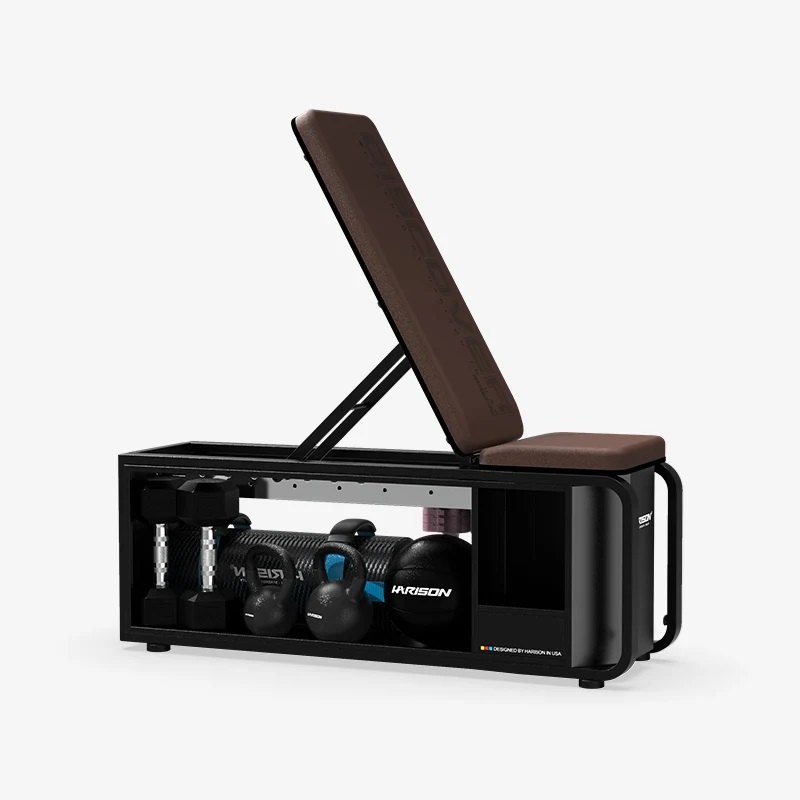
HARISON HR-610 Multi-functional Weight Bench
Essential Considerations for Safe & Effective Workouts
To ensure you get the absolute most out of your home gym routine while avoiding injuries, keep these golden rules in mind:
| Principle | What It Means | Why It Matters |
| :— | :— | :— |
| **1. Dynamic Warm-Up** | 5-10 minutes of light movement and dynamic stretches before lifting. | Prepares your joints, increases blood flow, and prevents muscle pulls. |
| **2. Form Over Weight** | Prioritizing perfect technique over heavy numbers on the dumbbells. | Ensures correct muscle activation and protects your joints from wear. |
| **3. Progressive Overload** | Gradually increasing weight, reps, or sets over weeks and months. | Forces your muscles to continually adapt, grow stronger, and tone. |
| **4. Rest and Recovery** | Taking 48 hours of rest between training the same muscle groups. | Muscles grow *during* rest, not while you are actively working out in the gym. |
Sample 3-Day Beginner Weight Bench Routine
Put your new knowledge into action with this simple, highly effective 3-day full-body routine designed around a basic weight bench and dumbbells.
* Day 1: Upper Body Push & Pull
* Dumbbell Bench Press: 3 sets x 10 reps
* Supported Dumbbell Rows: 3 sets x 10 reps per side
* Incline Dumbbell Press: 3 sets x 12 reps
* Dumbbell Pullovers: 3 sets x 12 reps
* Day 2: Rest & Active Recovery (Light walking or stretching)
* Day 3: Lower Body & Core
* Weighted Step-Ups: 3 sets x 10 reps per leg
* Dumbbell Romanian Deadlifts (holding weights while hinging at hips): 3 sets x 12 reps
* Bodyweight Bulgarian Split Squats: 3 sets x 8 reps per leg
* Plank on Bench: 3 sets x 45 seconds hold
* Day 4 & 5: Rest or Light Cardio
* Day 6: Full Body Hypertrophy Circuit (Repeat Day 1 & 3 movements with lighter weights for higher reps).
Conclusion: Start Your Strength Journey Today!
Incorporating these five essential exercises into your routine will lay an unbreakable foundation for your strength training goals. Your weight bench is much more than just a piece of padded metal and vinyl; it is a gateway to a stronger, healthier, and more confident you.
Grab your free weights, step up to your workout bench, and start building the physique you’ve always wanted in the comfort and privacy of your home gym. Consistency is the ultimate key to success—commit to your routine, listen to your body, and enjoy the incredible progress you will make week after week!



Leave a Reply
Want to join the discussion?Feel free to contribute!